
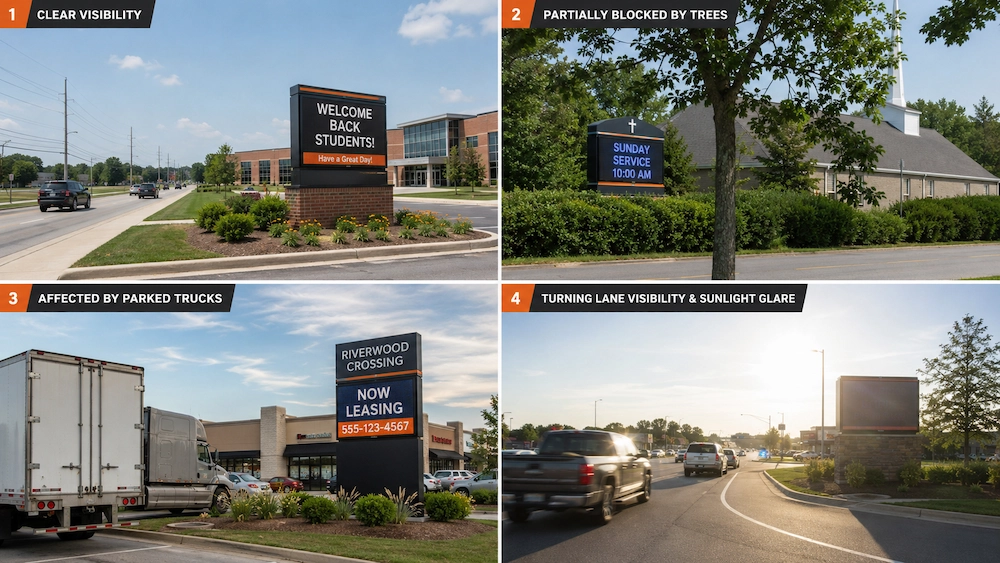
TL;DR:LED sign placement can make or break visibility, even when the display is bright, clear, and well-designed. The best results come from matching the sign’s location to viewing distance, traffic speed, sightlines, and the way people actually move through the area.
Key Takeaways
A bright LED sign can still fail when people cannot see it clearly, read it in time, or act before they pass by. For businesses, schools, churches, restaurants, gas stations, HOAs, medical centers, fire stations, and sports venues, that can turn a useful display into a missed opportunity.
The issue is often not the screen itself, but where it is placed. LED sign placement affects whether your message gets noticed, understood, and remembered before traffic, obstacles, or poor angles get in the way.
Most sign problems get blamed on brightness, size, or content, but those are only part of the picture. A sign can be bright, large, and well-designed, yet still fail if drivers cannot see it comfortably, read it in time, or get a clear view past trees, poles, parked trucks, or nearby signs.
Instead of asking how big the sign can be, start by asking where people will actually see it from. A roadside business, school, church, or stadium all have different viewing conditions, so the sign’s placement, angle, size, and message timing should match how people approach the site.
Viewing distance is the space between the sign and the person who needs to read it. It affects the sign’s size, text height, message length, mounting height, and content style.
When a sign is too far away, the text can look small and easy to miss. When it is too close, people may see it for only a second before they pass the driveway, corner, or entrance.
Good LED sign placement starts by following the viewer’s path, whether that means walking the site or driving past it. Check where the sign first becomes visible and how long it stays in view, because that window matters more than how it looks up close.
A larger display can help, but it will not fix poor placement. If the sign faces the wrong way, sits behind obstacles, or appears too late, a bigger screen can make the problem more costly.
The better move is to match each part of the sign setup to the real viewing distance:
Faraway traffic needs bold contrast, larger text, and fewer words, while slower viewers can handle more detail as long as the layout stays clean.
Traffic speed is one of the most overlooked parts of LED sign placement. Many signs are designed as if viewers are standing still, but most outdoor signs are seen by people in motion. The faster someone moves, the less time they have to read.
A driver on a slow street may have enough time to notice a sign and decide whether to turn. On a busy road, a long or crowded message can disappear in a glance, especially if the sign appears too late.
For higher-speed traffic, the sign should focus on one clear idea at a time instead of trying to say everything at once. Schools, gas stations, medical centers, and sports venues can still share useful updates, but the message needs to be simple enough for people to catch in a quick glance.
Getting noticed is not enough because viewers also need time to respond. If drivers see the sign after passing the entrance, it is already too late to turn, park, or follow the right path.
Line of sight means the clear visual path between the viewer and the sign. If something breaks that path, the sign loses impact.
Line-of-sight problems are not always obvious during planning because a site can look clear at one time of day and blocked at another. Delivery trucks, parked cars, growing landscaping, and low monument signs can all get between the viewer and the message.
Do not judge placement from the property line alone, because that is rarely where people first see the sign. Check the view from:
If the site hosts evening events, review the sign after dark to see how it reads at night. If the screen faces direct sun, check it during harsh daylight so glare does not weaken the message.
A clear view today can be blocked later by growing trees, seasonal banners, new signs, parked cars, or changes in traffic flow. Good planning looks past the install date and places the sign where it can stay visible, accessible, and easy to service over time.
Placement and content work together, so even a well-placed sign can underperform when the message is crowded. A clean message can also fail if the sign appears where people only have a moment to read it.
The less time viewers have, the simpler the message should be. Fast traffic needs fewer words, strong contrast, and larger text, while slower viewers can handle more detail if the layout stays easy to scan.
Before a message goes live, decide what people should notice first and understand in one quick glance. Then make the action clear, whether you want them to turn, visit, register, attend, use an entrance, or check a schedule.
Before final placement is approved, check the site from the same places your audience will see it. Drive past at normal traffic speed, look from each direction, and watch for blocked views, glare, turning points, and pedestrian paths.
Also consider service access and local sign rules before the display is ordered. Mounting height, cabinet access, power access, setbacks, size limits, brightness rules, and other restrictions can affect the final location and help prevent costly changes later.
Poor placement can waste money on a larger display than you need, extra content changes, or service issues caused by poor access. It can also make a good sign feel less effective simply because people cannot read it clearly or see it at the right time.
Smart LED sign placement helps your sign attract attention, guide visitors, and share updates clearly. For schools, churches, restaurants, retail centers, sports venues, HOAs, medical centers, fire stations, and commercial properties, that means better visibility with fewer headaches.
LED Partners approaches signage as a full project, not just a display purchase. That matters because the right sign depends on the site, audience, viewing distance, traffic speed, line of sight, mounting setup, content needs, permitting, and support after installation.
For outdoor LED signs, digital marquees, scoreboards, video walls, and custom display projects, the best results come from planning the whole system before the screen is installed. A display should be chosen for how it will perform in its actual environment, not how it looks in a product photo.
Before you choose a screen size or approve an install location, talk with LED Partners about your site, traffic flow, viewing distance, and message goals. The right placement can make the difference between a sign people pass by and a sign people notice, read, and act on.