Indoor LED Video Walls That Look Crisp Up Close and Stay Reliable Long-Term
Indoor LED video walls solve a problem LCD video walls never fully fixed: bezels, uneven brightness, and the “panel mismatch” look. A good dvLED wall is a seamless canvas that stays sharp at your seating distance and still looks premium when the room lights are on. Pixel pitch is the make-or-break decision, because it controls viewing distance, perceived sharpness, and cost.
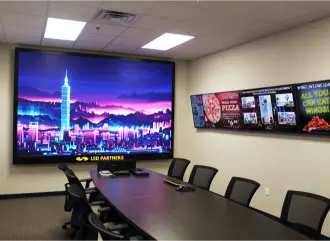
If your audience sits close, LED wins when you want a high-impact screen without bezels for meetings, presentations, or branded experiences. This is why dvLED is commonly specced for executive boardrooms, collaboration spaces, retail flagship walls, hotel lobbies, and command/control environments where readability matters.
Pixel Pitch and Viewing Distance
Here’s the straight rule of thumb many integrators use: for every 1.0mm of pixel pitch, the minimum “comfortable” viewing distance is roughly 1 metre, so a 1.2mm wall wants around 1.2m before it looks truly clean. A second useful reference is a pitch-to-distance table that places 0.9mm around 3–5 feet, 1.2mm around 5–7 feet, 1.5mm around 6–9 feet, and 2.6mm around 10–15 feet as a planning range.
Image Quality That Actually Shows Up in Real Rooms
Pixel pitch is not the whole story. Perceived resolution depends on screen size and seating distance, and a wall doesn’t need to be “native 4K pixels” to look razor sharp at typical meeting-room distances if the pitch and size are matched properly. That’s why we spec from your room geometry first, not from a brochure.
“Looks Bad on Camera” and How to Avoid It
If your wall will ever be filmed, streamed, or used behind presenters, you need to think beyond what the human eye sees. Camera banding and flicker can happen when refresh behaviour, PWM dimming, and camera shutter settings clash, even if the wall looks perfect in person.
All-in-One Indoor LED Walls for Meeting Rooms
If you want the simplest path, “all-in-one” dvLED packages bundle the display, mounting/frame, controller (and often audio) to reduce complexity and speed up installs. Samsung’s “The Wall All-in-One” positions itself exactly this way, including built-in controller/frame and a simplified installation approach.
Integration and Control
An indoor LED wall only delivers ROI if your team can operate it without fear. That means predictable inputs, simple switching, and a content workflow that fits how you already run meetings and events. Your page should promise a clean handover: setup, configuration, and training so it doesn’t become a permanently “paused” screen in a premium room.
Start with viewing distance. A common starting point is roughly 1 metre of ideal viewing distance per 1.0mm of pixel pitch, then adjust based on room lighting, content type, and how critical fine text readability is.
Yes, depending on size and seating distance. Integrator guidance notes that perceived sharpness depends on angular resolution at typical viewing distances, so a properly specced wall can look extremely sharp even if its native pixel count isn’t exactly 3840×2160.
It can if the wall’s refresh behaviour and dimming method interact badly with camera shutter and frame rate. If filming matters, the wall must be specced and configured with that in mind, not treated as an afterthought.
Want an indoor LED video wall that looks sharp at your seating distance and won’t become a maintenance headache?
Send us your room dimensions, typical viewing distance, and what you’ll use the wall for (meetings, signage, control-room data, filming). We’ll recommend the right pixel pitch and system design so you don’t overbuy, underbuy, or end up with a wall that looks great only in the showroom.